Studying for the Pathologists’ Assistant certification exam can be overwhelming.
By the time you graduate from a PA program, you’ve accumulated an enormous amount of information: general pathology, systemic pathology, anatomy, histology, autopsy, surgical pathology, laboratory techniques, and countless smaller details scattered throughout each subject.
At some point, studying can start to feel less like learning and more like trying to determine how much information you can possibly fit into your head before exam day.
You might start asking yourself:
How deeply should I actually know the material, and what kinds of questions should I be using to test myself?
That is an important distinction when preparing for either the ASCP or CCCPA certification exam. You can’t memorize every sentence in Robbins. Instead, you need to decide what deserves memorization, what requires conceptual understanding, and what you should be able to apply in an unfamiliar scenario.
A simple way to think about certification exam prep:
Memorize the facts that have to be known.
Understand how those facts relate to one another.
Practice applying them when the question doesn’t tell you exactly what it’s asking about.
Here are some of the strategies I used when preparing for my certification exams.
Don’t Just Review the Material – Test Yourself
Rereading a chapter can make material feel familiar and highlighting can help organize information.
But these are both a trap!

Neither proves that you can retrieve or apply that information when you’re staring at four plausible answer choices on an exam.
Practice questions are useful because they force you to retrieve information without the answer sitting in front of you. Short answer can be brutal but effective for this. Multiple-choice questions work too.
Forcing yourself to retrieve the information this way without immediately looking through your notes or the textbook strengthens your ability to retrieve that information again later. In fact, the mental struggle involved in trying to recall an answer is part of the learning process. If you have to think hard before the answer comes to you, that’s not a sign that the exercise isn’t working – that effort is the point.
You can also take this one step further by writing some of your own questions.
When I write questions, I go through the textbook and ask what a question about that concept would look like. Bolded terms describing the morphologic or histologic features of a disease are a good place to start. As are what I consider foundational concepts, which later material refers back to repeatedly.
But I rarely expect to see a question like this on the exam:
An increase in cell size is an example of ______ (atrophy, hypertrophy, metaplasia, dysplasia).
Instead, I ask myself: How can I prove to myself that I understand this, and what would I need to know to truly understand it? Then I build a question around that, one that asks more than “what is X?”
Sometimes the answer is obvious. A characteristic mutation, translocation, histologic feature, or morphologic finding may simply need to be memorized.
But many concepts can be pushed further than simple recall.
Instead of only asking:
What is x?
Try asking:
What causes x?
Then:
What happens because of x?
That simple progression forces you to connect pieces of information rather than memorize them independently.
A habit that makes your questions more exam-like
Describe findings in plain language. Get used to writing the finding instead of the medical term for it. Clinical scenario questions often present things this way.
| Instead of writing | Try writing |
|---|---|
| A patient presents with hematemesis… | A patient presents after vomiting a large amount of blood… |
| A patient came from a region where HBV is endemic | The patient was born in Nigeria, moved to North America at age 10 |
It might feel a bit odd at first. But if you aren’t used to translating descriptions into findings, questions will feel harder than they are. This is something that caught me off guard.
Scale Questions From Recall to Application
Not every practice question needs to be difficult and I think there’s value in testing the same concept at several levels.
Here’s how the same idea, periductal fibrosis in primary sclerosing cholangitis (PSC), can be asked at increasing difficulty.
Easy. Which histologic pattern is classically associated with primary sclerosing cholangitis?
- A. Bridging fibrosis between portal tracts
- B. Periductal “onion skin” fibrosis
- C. Steatosis of hepatocytes
- D. Granulomatous inflammation
The answer is B: periductal “onion skin” fibrosis
A slightly more difficult question removes the terminology:
Medium. A liver biopsy shows concentric rings of fibrosis surrounding and progressively narrowing a bile duct. Which term best describes this finding?
- A. Interface hepatitis
- B. Onion skin fibrosis
- C. Mallory-Denk bodies
- D. Ballooning degeneration
The answer is B: onion skin fibrosis
But you could push the same concept even further:
Hard. A 41-year-old man presents with fatigue and itching. Imaging shows multifocal strictures of the bile ducts. Liver biopsy shows concentric fibrosis around the bile ducts with progressive narrowing, eventually leaving a dense fibrous scar with no duct lumen. Which of the following best describes the end-stage lesion in this process?
- A. Caseating granuloma
- B. Fatty change of hepatocytes
- C. A “tombstone” scar replacing an obliterated bile duct
- D. Sinusoidal congestion
The answer is C: a tombstone scar replacing an obliterated bile duct.
Now you need to recognize the clinical context, connect it to PSC, understand the progression of the bile duct injury, and identify the resulting “tombstone” scar.
The underlying pathology hasn’t changed.
The easy question names the disease and asks for the associated finding. The medium question removes the disease and asks you to recognize the finding from its description. The hard question requires you to recognize the disease from the clinical context, understand the progression of the bile duct injury and identify the resulting lesion.
If you are creating your own study questions, try testing concepts at multiple levels like this.
Don’t Judge Your Readiness Solely by Robbins Review Questions
Robbins Review of Pathology can be an excellent source of practice questions, but there is an important caveat for PA students:
You are not training to become a pathologist.
Many Robbins review questions are written for a broader medical audience and can extend beyond what I would consider reasonable PA-level knowledge.
If you’re doing well with PA-specific review material but suddenly getting destroyed by Robbins questions, don’t automatically interpret that as evidence that you’re unprepared.
Instead, pay attention to why you’re getting questions wrong.
Did you misunderstand an important pathology concept? Did you know the concept but fail to recognize how it was being presented?
Or was the question testing something substantially outside the scope of PA practice and your PA program?
Use Multiple Question Sources
There is another potential problem with relying too heavily on a single question bank: you can become good at answering that author’s questions rather than becoming better at pathology.
I used several resources while studying, including questions I made for myself based on recommended textbooks, Robbins Review of Pathology, study material from the AAPA and the Board Review Series (BRS) Pathology book.
BRS was particularly useful because it combined relatively concise pathology review material with practice questions.
Seeing the same concept asked in different ways helps determine whether you actually understand the material or have simply become familiar with the style of one particular question bank.
If you consistently answer a concept correctly when it is presented differently, that’s much stronger evidence that you understand it.
Explain the Answer – Including Why the Other Answers Are Wrong
When you answer a practice question, don’t always move on when you identify the correct answer, especially if you guessed.
Try explaining:
Why is this answer correct?
Then look at the remaining choices:
Why are these answers incorrect?
If you don’t know right away, take 30-60 seconds and push yourself to come up with an answer before looking it up. This turns one multiple-choice question into several retrieval opportunities and will help consolidate the knowledge better than immediately looking up a wrong answer.
If one of the incorrect answers is something you don’t recognize and you can’t come up with an explanation of what it is, then go look it up.
You can also pretend you’re teaching the concept to someone else. I used to explain concepts and practice questions out loud to an imaginary person while studying.
It sounds a bit weird, but it works.
If you can’t explain something clearly or at a very basic level and without looking at your notes, there is probably a gap in your understanding.
AI tools can also be useful for this type of studying. For example, you can ask an AI assistant to use the Socratic method to test you on a particular concept: rather than immediately explaining a concept to you, have it ask you progressively deeper questions until it finds the limits of your understanding.
The goal isn’t to use AI to give you the answer but to make you retrieve and explain the answer.
Fair warning: if you try this out, prepare to be humbled. Try something that you feel should be relatively easy and in your wheelhouse. Tell an AI chatbot you’re a pathologists’ assistant student and ask it the following: “Use the Socratic method to test my understanding on the development of neoplasia.” See what you get from that and where the conversation takes you.
Recognize What Actually Requires Memorization
Not everything can be learned through conceptual understanding.
Some information simply needs to be memorized.
You either know the translocation associated with Burkitt lymphoma or you don’t.
Anatomical relationships can be similar. You may need to know the anterior-to-posterior arrangement of structures at the renal hilum or use the insertions of the extraocular muscles to orient an eye specimen.
Histotechnology also contains plenty of information that lends itself to straightforward recall:
- Which stain demonstrates a particular organism?
- Which stain demonstrates glycogen, fat, iron, or amyloid?
- Which fixative should be used for a particular specimen or technique?
Trying to build an elaborate conceptual framework around every fact isn’t necessarily an efficient use of your time.
The trick is recognizing which material represents facts you need to memorize and which represents concepts you need to understand. I found that the material that I needed to straight up memorize often became a building block or a foundational piece of knowledge to have when it came to later understanding specific concepts.
Take KRAS and the classic adenoma-carcinoma sequence in colorectal cancer as an example.
A fact you need to know might be:
KRAS is a proto-oncogene that encodes a small GTP-binding protein involved in transmitting growth signals within the cell. Activating mutations can lock KRAS in its active, GTP-bound state, promoting persistent downstream growth signaling. Or, more simply, KRAS is a gene involved in transmitting growth signals within the cell. When an activating mutation occurs, KRAS can become locked in an active state, continuously promoting growth signaling.
That’s foundational knowledge and you need some version of that information stored in your head before you can do much with it.
But then you can ask a more conceptual question:
What happens to a colonic epithelial cell when KRAS becomes constitutively active, and where might that mutation fit into the progression from normal colonic epithelium to carcinoma?
Now several pieces of memorized information need to be connected.
Oncogenes generally result from gain-of-function mutations and act dominantly at the cellular level, meaning mutation of one allele can be sufficient to contribute to abnormal growth signaling. An activating KRAS mutation produces persistent downstream signaling even without the normal upstream growth-factor signal, helping drive proliferation and progression of a neoplastic clone.
In the classic colorectal adenoma-carcinoma sequence, loss of APC function is typically an early event that promotes formation of an adenoma. Acquisition of an activating KRAS mutation can then contribute to further adenoma growth and progression, while later alterations – including loss of TP53 – help drive progression toward invasive carcinoma.
So the memorized facts become pieces of a larger chain:
APC loss → early adenoma → KRAS activation → adenoma progression → additional alterations including TP53 loss → carcinoma
You don’t only know what KRAS is at this point. You understand what happens when it is mutated, why that matters to the cell, and how that alteration can fit into a larger model of tumor progression.
That’s the distinction I’m looking for when I talk about memorization vs understanding. Memorization often provides the pieces you need in order to build understanding.
Let the Certification Exam Content Outline Guide Your Studying
When you’re confronted with hundreds or thousands of pages of potential study material, not every topic deserves equal time.
Use the official certification exam content outline as your map and use the weighting to decide where to allocate your study time.
General and systemic pathology represent a substantial portion of the material (~50%!), so general and systemic pathology deserves a substantial portion of your prep.
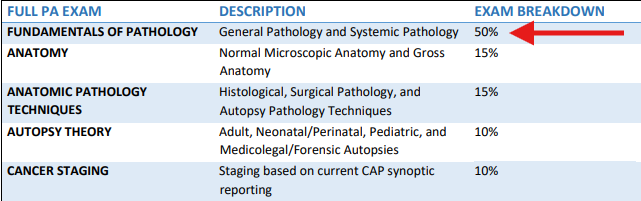
Within pathology, I would place particular emphasis on systemic pathology. If you’re working from Robbins & Cotran Pathologic Basis of Disease, this broadly corresponds to the organ-system chapters – GI, lung, male reproductive tract, CNS, etc.
General pathology remains important – cell injury, neoplasia, immunopathology, infectious disease, genetic and metabolic disorders, environmental and nutritional pathology, and fluid and hemodynamic disorders all provide foundations that appear throughout systemic pathology.
But systemic pathology gives you repeated opportunities to apply those general principles to specific organs and diseases.
Don’t Forget the Smaller Exam Categories
Depending on the certification exam and current content outline, these categories include areas such as anatomy, histology, autopsy, surgical pathology, and laboratory/histotechnology techniques and cancer staging.
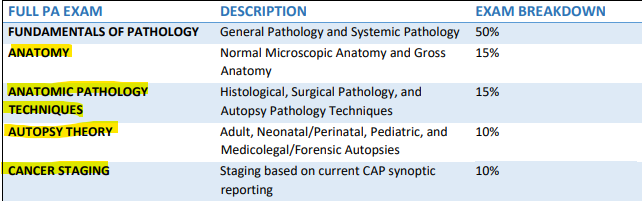
Some of these areas may require relatively little additional review because they’re reinforced constantly during PA training.
Others may expose gaps you didn’t realize you had.
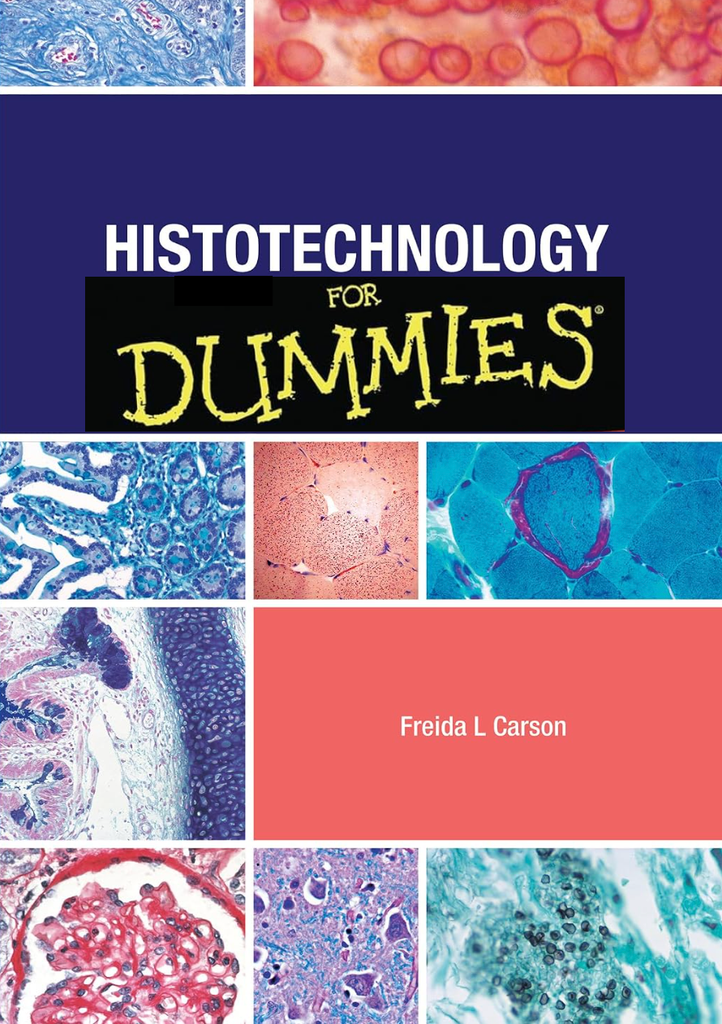
I felt fairly comfortable with microscopic anatomy (aka histology) but histotechnology was one of those areas for me.
I came across practice questions about stains, fixatives, organisms, substances, and laboratory techniques that hadn’t received much attention during my training and trying to brute force memorize example questions I came across wasn’t helpful.
It felt like trying to memorize something in a different language. So… I bought a textbook specifically to fill that gap. Like getting Spanish for Dummies, but for histotechnology (the actual book is Carson’s Histotechnology).
Autopsy preparation may include subjects such as different evisceration techniques, explanations of cause vs mechanism vs manner of death, specimen collection, forensic findings, and other specialized techniques.
You don’t need to become an expert in every one of these areas but your study plan should reflect the whole exam, not simply the largest textbook you’re using (typically Robbins).
If you have 10 hours a week to study, you might spend roughly half of that time on general and systemic pathology, then distribute the remaining time among anatomy, AP techniques, autopsy, histology/histotechnology, cancer staging, and other categories according to the weighting of the exam you’re preparing for and your own areas of weakness.
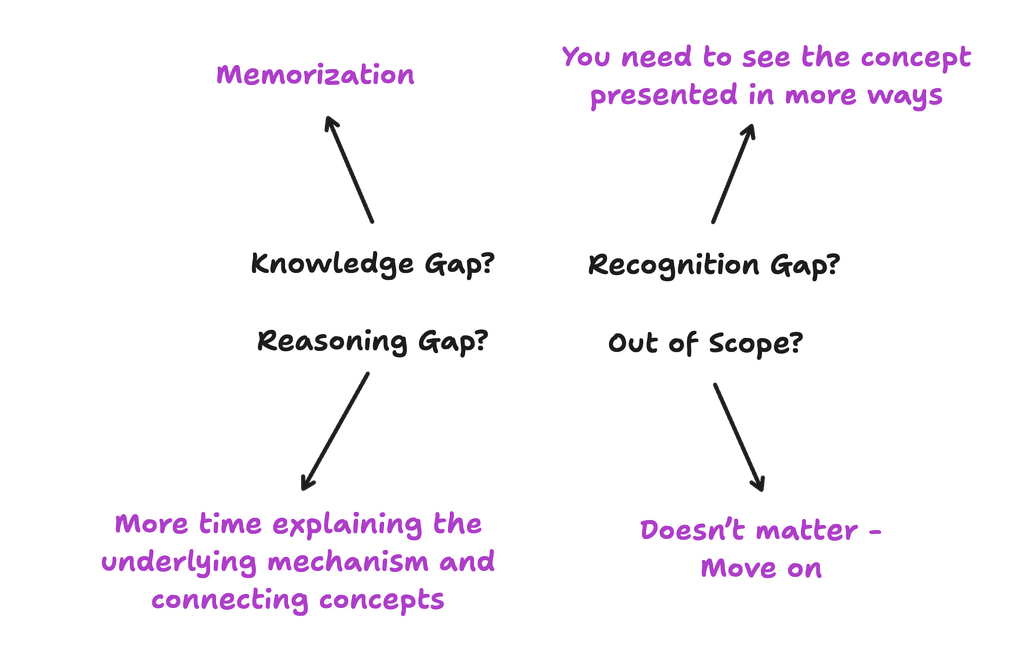
Use Your Wrong Answers to Decide What to Study Next
Practice questions aren’t just a way to measure your knowledge. They’re also a way to decide what you should study tomorrow.
When you miss a question, determine why and adjust your future review accordingly.
Was it:
A knowledge gap?
You simply didn’t know the information.
A recognition gap?
You knew the information but didn’t recognize it when described differently.
A reasoning gap?
You knew the individual facts but couldn’t connect them.
An out-of-scope question?
The question was testing material considerably beyond what you reasonably need for PA certification.
Those categories require different responses:
You Will Never Feel Like You Know Everything
Perhaps the hardest part of preparing for a certification exam is accepting that there will always be something else you could study.
You can finish one Robbins chapter and immediately identify five other topics you don’t know as well as you’d like.
That doesn’t necessarily mean you’re unprepared and the goal isn’t to memorize the entire textbook.
You’re trying to develop a broad enough knowledge base that you can recognize common and important concepts, retrieve key facts, and connect information when a question presents something in an unfamiliar way.
As the exam approaches, I would increasingly shift away from asking:
“Have I reviewed everything?”
and toward:
“Can I retrieve and apply the important things I’ve already studied?”
Final Thoughts
If I were preparing for a PA certification exam again, my general approach would be:
- Use the official exam content outline to prioritize my study time and topics for review.
- Spend a large portion of that time on systemic pathology.
- Use active recall and practice questions rather than relying primarily on rereading.
- Study important concepts as cause-and-effect relationships rather than isolated facts.
- Practice recognizing diseases and findings when the terminology isn’t explicitly provided.
- Use multiple question sources so I don’t become dependent on one author’s question style.
- Explain why answers are correct – and why the alternatives are wrong.
- Identify material that requires rote memorization and commit that to memory.
- Use missed questions to identify specific weaknesses (topic areas, knowledge vs reasoning gaps etc).
- Remember that difficult questions from resources designed for physicians and pathology residents aren’t necessarily a measure of readiness or ability to work as a Pathologists’ Assistant.
Feeling overwhelmed by the amount of material is understandable. There is a lot to know.
You don’t need to memorize every sentence in every textbook. Prioritize what the exam expects you to know, identify what needs to be memorized vs understood, and test yourself frequently enough to prove that you can retrieve and apply it.