If you are new to pathology, you will hear the word margin a lot.
Pathologists talk about margins.
Pathologists’ Assistants talk about margins.
Surgeons ask about margins in almost every cancer case.
But what exactly is a margin?
And why does it matter so much?
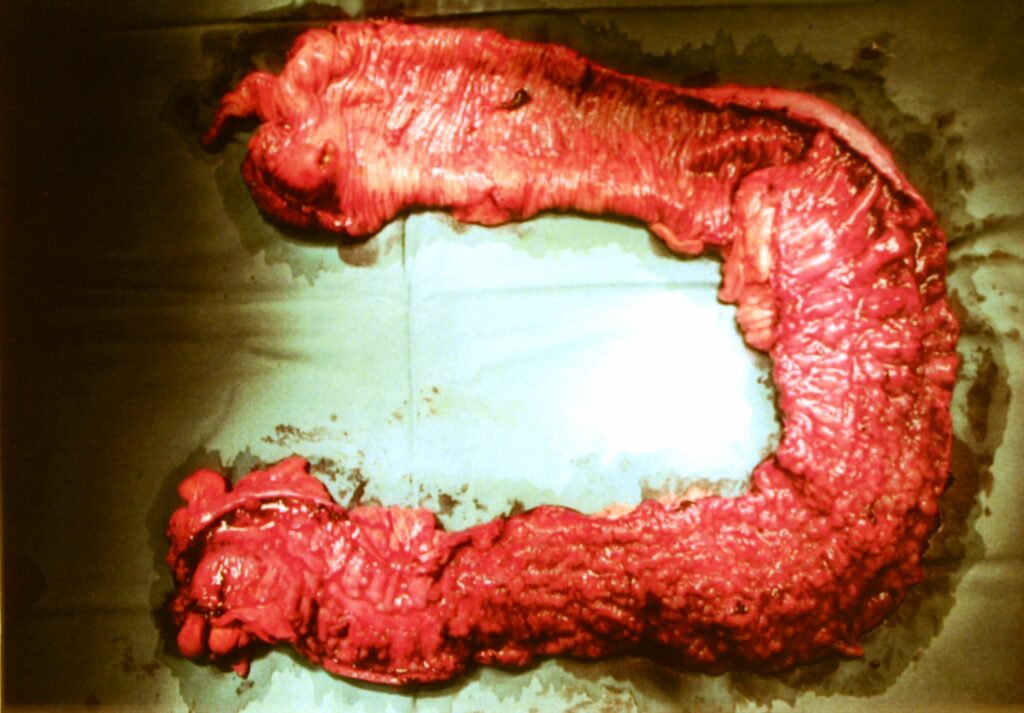
“Large bowel resection specimen” by fatmandy, used under CC BY-NC-ND 2.0. Source: Flickr.
Where are the margins???
What Does “Margin” Mean in Surgical Pathology?
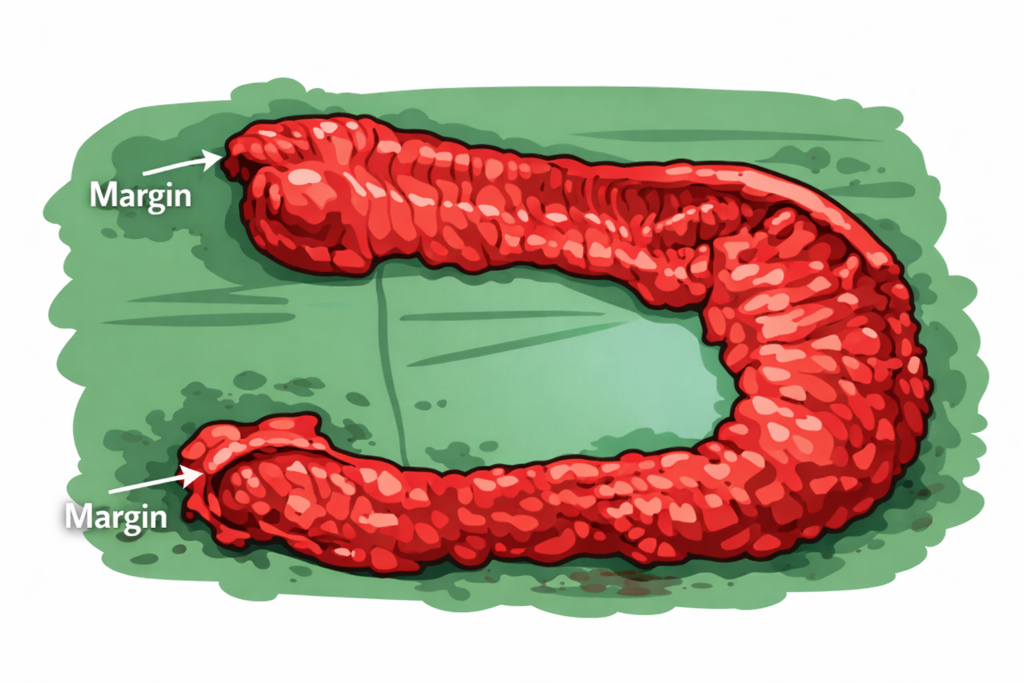
In surgical pathology, a margin is the edge of the tissue that was cut by the surgeon during surgery.
This edge is created when the surgeon:
- Cuts through tissue with a scalpel
- Uses scissors or cautery
- Uses their fingers to separate tissue from the rest of the body
Once that tissue is removed from the patient and sent to the lab, those cut edges become the margins.
In simple terms:
A margin is the border between what was removed and what is still left inside the patient.
Why Are Margins So Important?
Margins help answer one critical question:
Did the surgeon remove all of the disease?
When a PA or pathologist looks at a specimen, they are often checking how close a disease process comes to the edge of the tissue. This could be:
- Cancer
- Severe inflammation
- Dead or dying tissue
- Infection
- Abnormal growths
If the disease is far away from the margin, that usually means it was fully removed.
If the disease reaches the margin, that means something important.
What Does “Positive Margin” Mean?
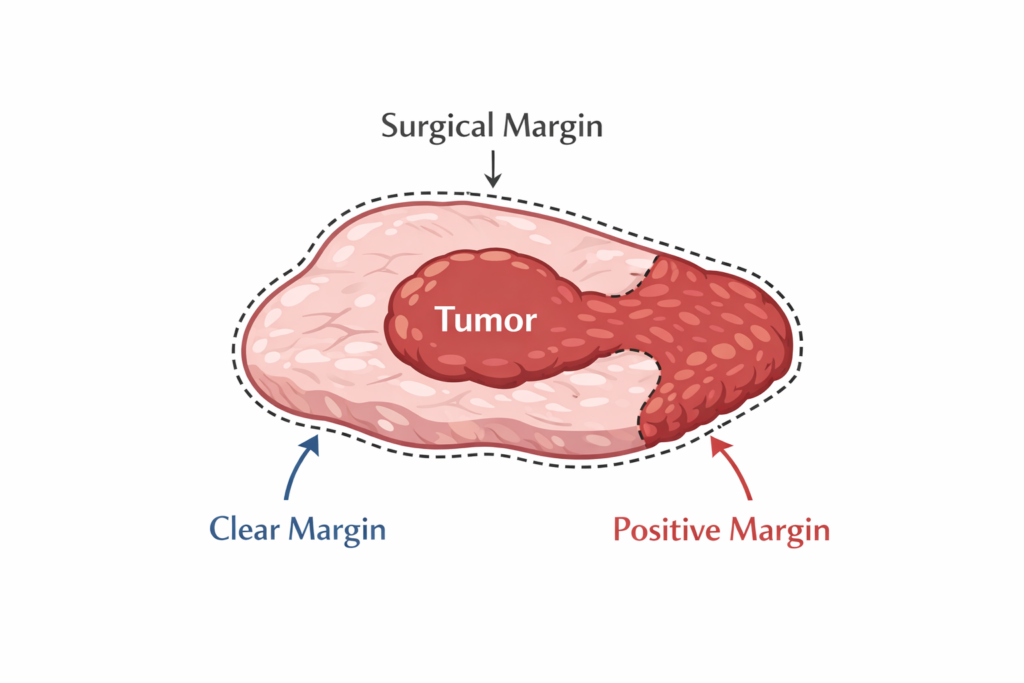
If pathology is found at the margin, it means the surgeon was not able to remove all of it.
This is often called a positive margin.
In other words:
- The disease goes right up to the cut edge
- There is likely still disease left inside the patient
This is especially important in cancer cases.
Margins and Cancer Surgery
When someone has surgery for cancer, the goal is to remove:
- The tumor
- A rim of normal tissue around it
This lowers the chance that the cancer will come back.
If cancer is found at the margin, it means:
- Some cancer cells were left behind
- The cancer could regrow
- The patient may need more surgery, radiation, or chemotherapy
That is why surgeons, oncologists, and patients care so much about margin status.
Are Margins Always About Cancer?
No.
Margins matter most in cancer, but they are also important in other situations.
For example, when a surgeon removes:
- Severely inflamed tissue
- Dead or dying tissue
- Infected tissue
If some abnormal tissue is left behind, it may:
- Heal without issues
- Cause ongoing inflammation
- Increase the risk of infection
- Require further treatment
In these cases, a positive margin is still not ideal, but it may not carry the same long-term risk as cancer.
The Role of the PA and Pathologist
Pathologists’ Assistants help identify and sample margins correctly during grossing.
Pathologists examine those margins under the microscope.
Together, they help answer questions like:
- How close is the disease to the edge?
- Is the margin clear?
- Is the margin involved?
This information directly affects patient care and future treatment decisions.
Why This Concept Matters for Future PAs
Understanding what a margin is helps explain why we handle surgical specimens the way we do. It is the reason margins are carefully identified, inked, and sampled during grossing.
As a Pathologists’ Assistant, you are not randomly cutting up tissue. You are helping answer an important clinical question: did the surgeon remove all of the disease? Once you understand that connection, many parts of surgical pathology start to make more sense.
Margins are a simple concept, but they play a major role in how specimens are examined and how final pathology reports are written.