If you are a certified Pathologists’ Assistant (PA) through the American Society for Clinical Pathology (ASCP), maintaining your certification requires completing the ASCP Board of Certification Credential Maintenance Program (CMP).
Fortunately, the renewal process is fairly straightforward once you understand what is required. The bigger challenge is often keeping track of your continuing education credits, knowing what can be claimed for credits and making sure they are assigned to the correct categories before submitting your renewal.
In this guide, I’ll walk through the requirements for maintaining your PA(ASCP) certification, how to allocate your CMP points, and how to submit your completed CMP declaration.
I have also created a video walkthrough showing the process directly on the ASCP website. If you would prefer to see the process rather than just read about it, you can follow along with the video here:
Note: ASCP requirements and fees can change over time. This article reflects the requirements available at the time of writing. Always confirm your individual requirements through your ASCP account and the ASCP Board of Certification website.
What Is the ASCP Credential Maintenance Program?
The Credential Maintenance Program (CMP) is the continuing education program used by the ASCP Board of Certification to maintain time-limited ASCP credentials.
PA(ASCP) certification operates on a three-year credential cycle. During that period, you complete continuing education and other eligible professional activities to accumulate CMP points. Once you have met the requirements, you submit a CMP declaration to ASCP to renew your credential for another cycle.
Your required CMP points need to be earned within your current three-year credential cycle.
How Many CMP Points Do Pathologists’ Assistants Need?
Pathologists’ assistants currently need 60 CMP points during each three-year certification cycle.
Unfortunately it’s not as simple as just accumulating 60 random credits. Those points must be assigned to specific categories.
The current PA(ASCP) requirements are:
| CMP Category | Points Required |
|---|---|
| Advanced Anatomic Pathology (cancer specimen examination/staging) | 15 |
| Anatomic Pathology | 20 |
| Laboratory or Patient Safety (e.g., quality control, quality assurance, etc) | 1 |
| Medical Ethics (e.g., HIPAA, sexual harassment/microaggressions, compliance, confidentiality, IRB, etc) | 1 |
| Related areas of interest (e.g., advanced anatomic pathology, anatomic pathology, laboratory patient safety, medical ethics, management, education, or other clinical specialties) | Remaining 23 |
| Total | 60 |
ASCP PA CMP point distributions
This distribution is worth paying attention to. You don’t want to reach the end with 60+ credits only to discover that you haven’t satisfied one of the categories. Most of these should be fairly easy to get but the points within Laboratory/Patient Safety, and Medical Ethics are likely ones that you will have to intentionally seek out.
Checking Your CMP Progress
After logging into your ASCP account, navigate to the education section of your account and open your Credits & Progress information.
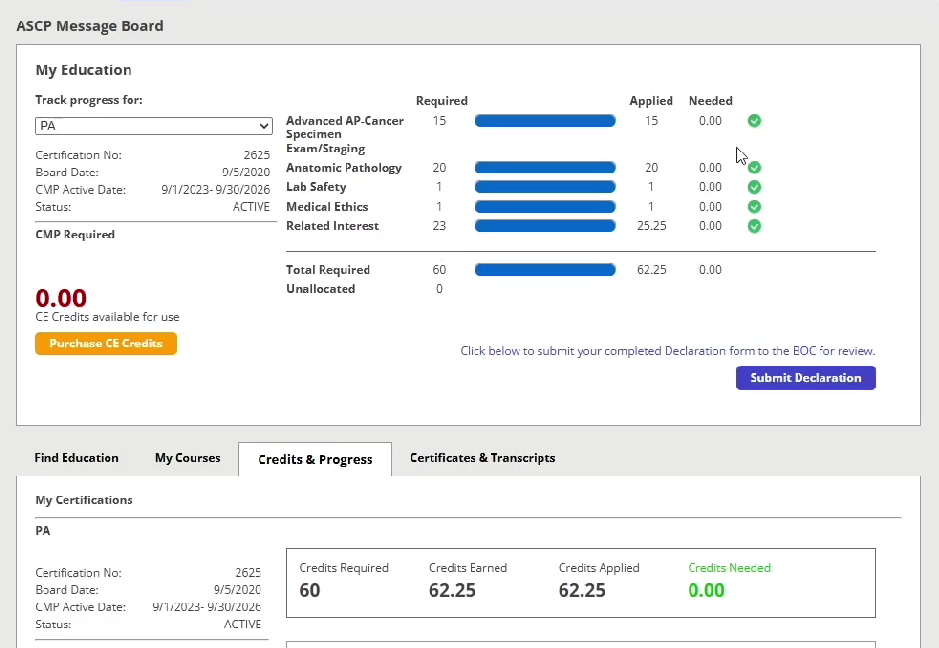
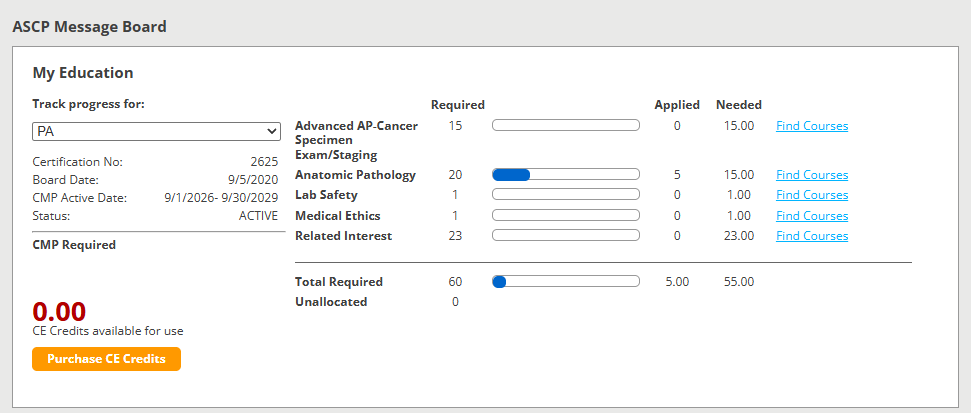
Your CMP dashboard provides a useful summary of where you currently stand. It displays your credential cycle dates along with the number of credits required, earned, applied, and still needed.
It also breaks your credit requirements down by category.
This makes it relatively easy to identify gaps. For example, you might have accumulated plenty of credits that you have applied towards Anatomic Pathology but still need credits to meet your Medical Ethics or Lab Safety requirement.
Where Can You Earn CMP Points?
Two convenient sources of continuing education for pathologists’ assistants are ASCP and the American Association of Pathologists’ Assistants (AAPA).
ASCP allows you to purchase continuing education courses directly through its website that can be completed for CMP credit. The AAPA also has a library of continuing education material available as a perk of membership.
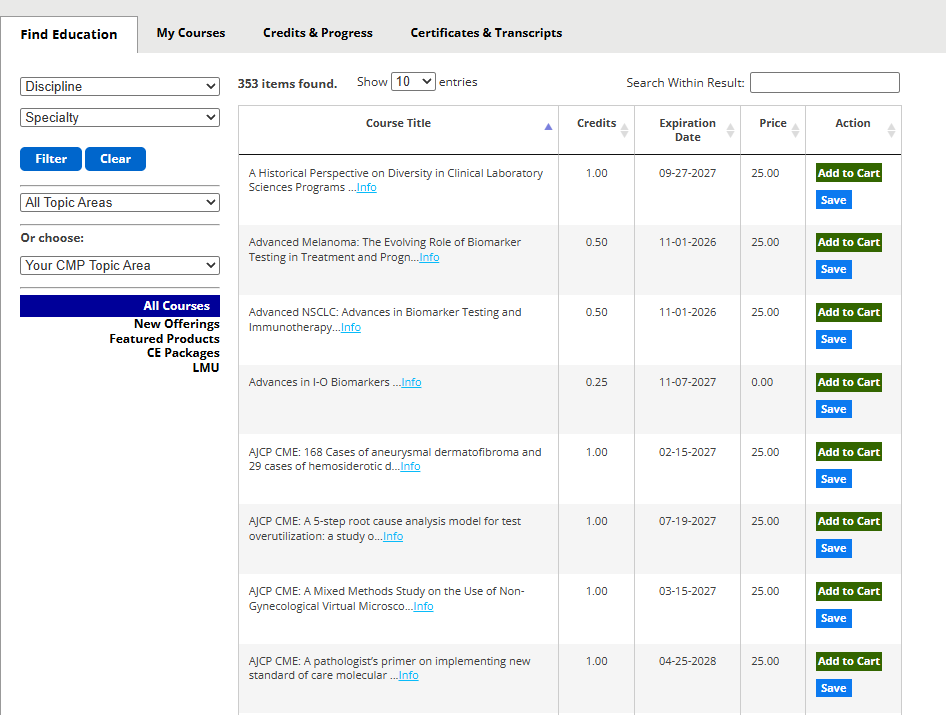
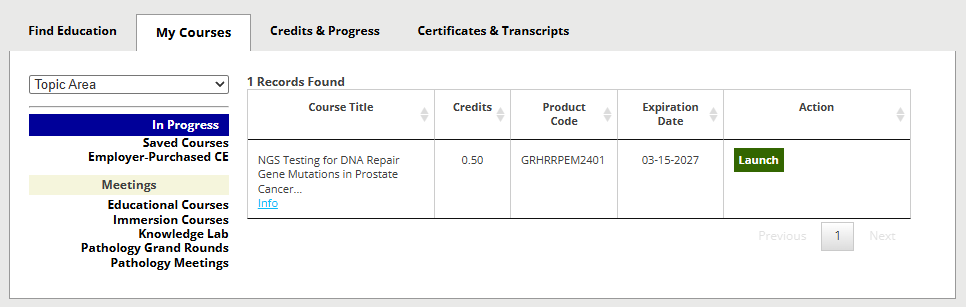
Personally I rarely use the ASCP courses but I use the AAPA CE store frequently because I find its material more applicable to pathologists’ assistants.
Courses and credits completed through ASCP should show up in your portal once completed. However, don’t assume that every continuing education activity you complete elsewhere will automatically appear in your ASCP account. Check your transcript periodically to verify that credits have transferred in, or be prepared to add non-ASCP credits manually.
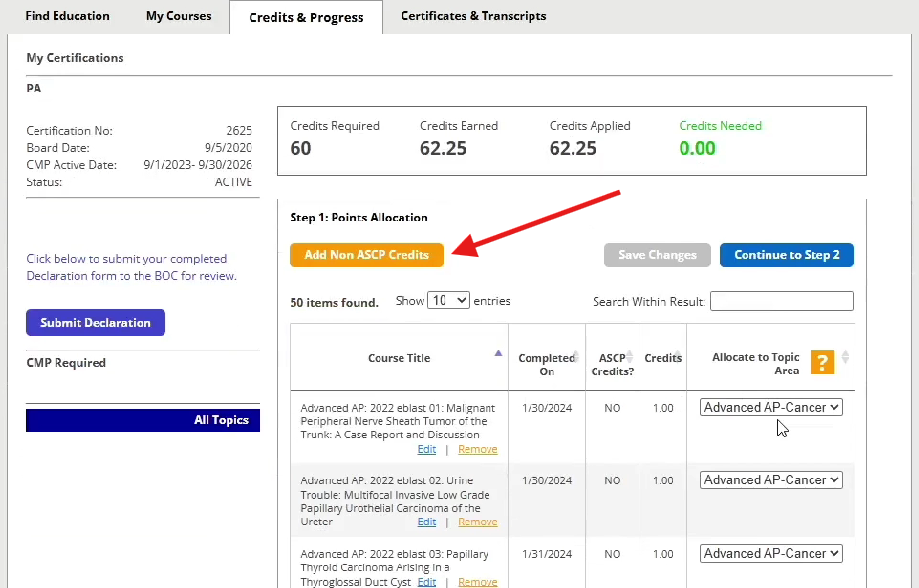
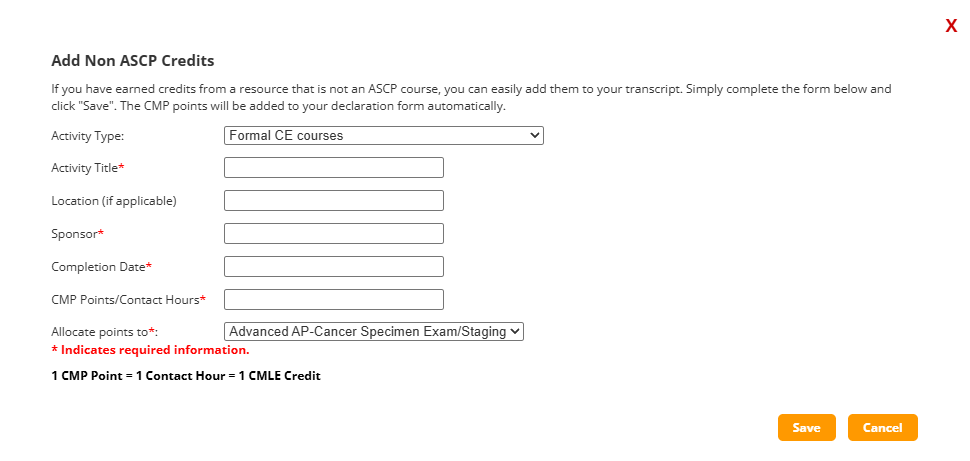
However, you don’t necessarily need to earn all of your CMP points through traditional continuing education courses. ASCP recognizes a much broader range of educational and professional activities that can count toward your credential maintenance requirements.
Ways to Earn ASCP CMP Points
You may already be participating in educational or professional activities through your regular work and professional development that can contribute toward your 60-point requirement.
According to the ASCP Board of Certification, eligible activities include:
- Formal continuing education courses – Courses offered through recognized continuing education providers, professional societies, colleges, universities, and other qualifying organizations. Generally, 50–60 minutes of instruction equals 1 CMP point.
- Employer-offered education – Structured in-services, workshops, instrument training, and vendor-sponsored education can qualify. Routine staff meetings and job orientation do not count.
- College or university coursework – Relevant coursework in areas such as biological, chemical or medical sciences, education, computer management, or other subjects applicable to your laboratory career can qualify. One semester hour is worth 15 CMP points and one quarter hour is worth 10 points, although coursework cannot account for more than 50% of your required CMP points.
- Webinars, podcasts, and online courses – Online learning can qualify when appropriate continuing education credits are awarded, when it is offered by a professional society or college/university, or when it is accepted by a state licensing board.
- Obtaining another ASCP BOC credential – Earning an additional ASCP credential can provide 10–20 CMP points depending on the type of credential earned.
- Employer competency assessment – Documented competency assessment through your employer can earn 2 CMP points, with a maximum of 4 points per CMP cycle.
- Clinical teaching – Teaching students during clinical rotations in an accredited laboratory educational program can earn 1 CMP point for every 50 contact hours of teaching, up to 3 points per CMP cycle.
- Preparing and delivering a presentation or workshop – Preparing and presenting new educational material outside the scope of your normal job can earn 3 CMP points for each contact hour of the presentation. Credit applies to the first presentation of that material and cannot exceed 50% of the total CMP requirement.
- Presenting a poster or professional exhibit – Posters or exhibits presented at qualifying laboratory professional meetings can earn 2 CMP points each, up to 4 points per year.
- Authoring a peer-reviewed journal article – A qualifying publication can earn 5 CMP points.
- Authoring a laboratory-related book or chapter – Writing a book can earn 20 CMP points, while writing a chapter or equivalent work, such as a monograph or study guide, can earn 7 points.
- Editing a laboratory-related book or chapter – Editing an entire book can earn 10 CMP points, while editing a chapter can earn 4.
- Reviewing professional publications – Reviewing a laboratory-related book can earn 5 CMP points, reviewing a chapter can earn 2, and reviewing a journal article can earn 1.
- Completing a doctoral dissertation – A relevant dissertation in science, education, management, or another laboratory-related field can earn 10 CMP points.
- Completing a master’s thesis – A relevant master’s thesis can earn 4 CMP points.
- Serving on an ASCP BOC examination committee, workgroup, or advisory board – This can earn 3 CMP points per year.
- Serving on other laboratory-related committees or boards – Service with professional organizations or qualifying committees at your place of employment can earn 3 CMP points per year.
- Serving as an accreditation inspector or reviewer – Participating as an on-site inspector or paper reviewer for qualifying laboratory or training-program accreditation can earn 3 CMP points per year.
There are a few important caveats. Activities need to be relevant to your credential, laboratory safety, or medical ethics, and some categories have limits on how many points can be applied during a CMP cycle. You should also retain the required documentation for each activity in case your CMP declaration is selected for audit.
The complete and most current requirements are available directly from the ASCP Board of Certification in its Guidelines for Completing Continuing Education Activities & CMP Point Assignment.
Don’t Overlook the Activities You Already Do
For practicing pathologists’ assistants, I think this is one of the most useful parts of the CMP program.
You may be accumulating eligible professional activities without thinking of them as “continuing education.”
For example, if you regularly teach PA students during their clinical rotations, those teaching hours may contribute toward your CMP requirements. If you prepare a presentation for a professional meeting, participate on a laboratory committee, complete employer competency assessments, or present a poster, those activities may also qualify.

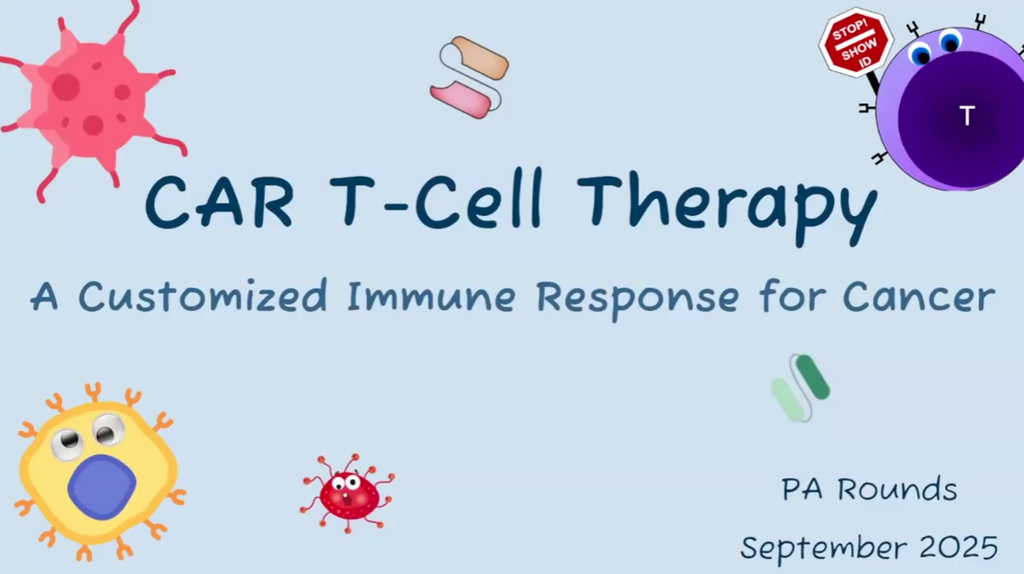
^Prepared presentations
That means maintaining your certification doesn’t necessarily require earning all 60 points by purchasing courses or attending conferences.
Personally, I would recommend looking through ASCP’s full list of qualifying activities early in your three-year cycle. You may discover several activities that are already part of your professional practice and can be documented for CMP credit.
Just remember to keep the documentation as you go. If ASCP selects your declaration for audit, you may be asked to provide supporting documentation for the continuing education activities you submitted.
Adding and Allocating CMP Credits
Once you’ve entered your credits into your account or your ASCP credits appear in your ASCP account (if you have purchased education courses through ASCP, once completed these will show up in your account for allocation), the next important step is allocating those credits to the appropriate CMP categories. If you manually entered any credits (shown below), you likely already completed this step when uploading each non-ASCP credit.
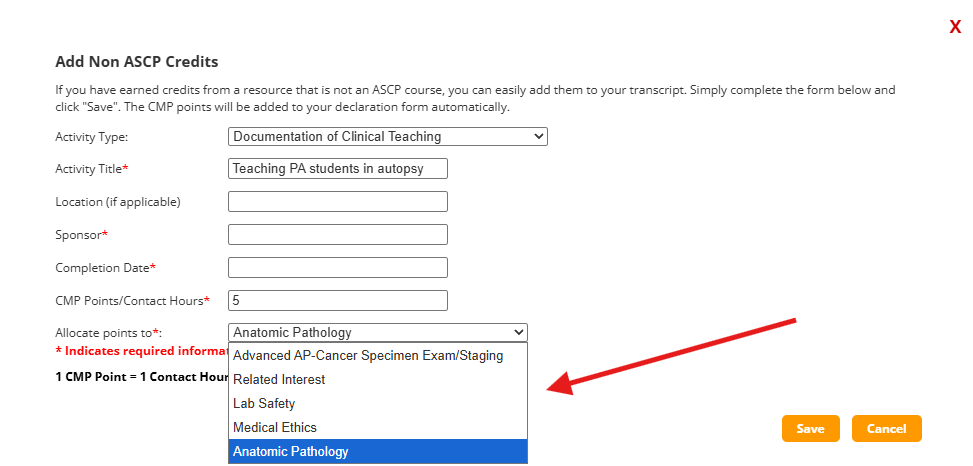
Assuming your credits aren’t allocated to a category, or if you need to modify where they’ve been allocated, look in the Credits & Progress section where your eligible activities appear in a list. For each activity, you can assign the credit to the appropriate topic area.
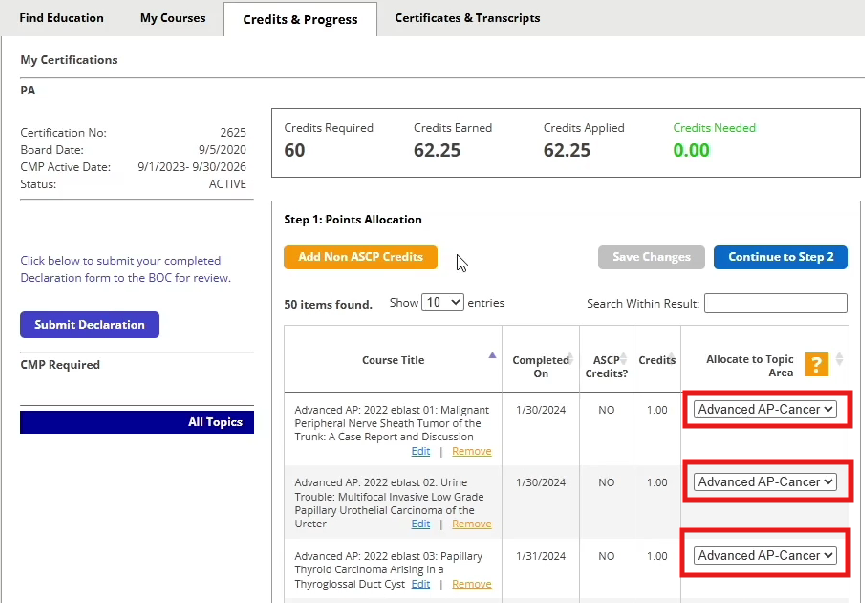
For a pathologists’ assistant, that may include categories such as:
Advanced AP – Cancer, Anatomic Pathology, Laboratory/Patient Safety, Medical Ethics, or Related Interest.
ASCP places responsibility on the credential holder (i.e. you) to allocate continuing education appropriately to the categories needed for your credential.
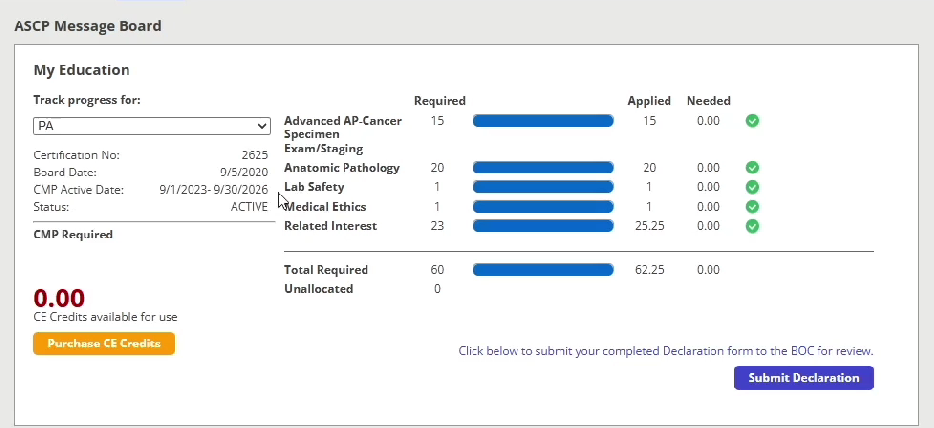
As you assign credits, the progress bars on your account update to show how many points have been applied and how many you still need.
You can also manually enter qualifying activities that do not already appear in your transcript. ASCP asks for information including the activity type, title, sponsor, completion date and number of credits/contact hours before the activity is allocated to the appropriate CMP category.
One useful conversion to remember is:
1 CMP point = 1 contact hour = 1 CMLE credit.
What Happens Once You Reach 60 Points?
Once you have satisfied both the 60-point total and the individual category requirements, your dashboard should show that you have no remaining credits needed.

At that point, you can proceed with your CMP declaration.
As shown in the video walkthrough, ASCP takes you through several additional screens as part of the submission process, including a survey and declaration before you reach the final submission and payment stage.
Take a final look at your credit allocation before submitting. Having more than 60 points is perfectly fine – the important thing is that you have met the required total and the minimum requirements for each category.
How Much Does ASCP Recertification Cost?
The current PA(ASCP) CMP application fee is $110 USD.
This is the fee you pay when submitting your completed CMP declaration.
If your credential has already expired, ASCP currently charges an additional $135 reinstatement fee on top of the CMP application fee.
That gives you another good reason not to leave the process until after your credential expires.
What Happens After You Submit?
Once your CMP requirements have been successfully completed, ASCP provides access to an electronic renewal letter showing your credential and its new validity dates. As of January 1, 2026, individuals successfully completing the ASCP BOC CMP also receive a digital badge through Credly.
Your new credential cycle then begins, and the process starts again.
My Advice: Don’t Wait Until the End of Your Three-Year Cycle
The easiest way to handle ASCP recertification is to treat it as an ongoing process rather than something you deal with every three years.
Check your ASCP transcript periodically, make sure credits from organizations such as AAPA are entered correctly, save your certificates and other documentation, and pay particular attention to the categories with specific minimum requirements.
Sixty points over three years is very manageable. It becomes more stressful when you discover shortly before your expiration date that you’re missing a specific category of continuing education.
If you are approaching your PA(ASCP) renewal and want to see exactly what the online process looks like, this video walks through my ASCP account and shows the process of reviewing CMP requirements, allocating credits, completing the declaration, and proceeding to payment.
For the most current requirements, you can also consult the official ASCP Board of Certification resources: