A question I get from prospective PA students is some version of: what does it actually take to succeed in this profession? Program coordinators will often point to “general aptitude for the PA profession” as something they look for in applicants, but that phrase doesn’t tell you much on its own. Here is my honest breakdown of the qualities, traits, and characteristics I think matter – both for getting into a program and for thriving once you’re working.
Understanding the Profession
Before getting into specific traits, I’d say one of the most important things programs look for is a demonstrated understanding of what a PA actually does. A surprising number of applicants cannot properly describe the role, and that alone can disqualify someone.
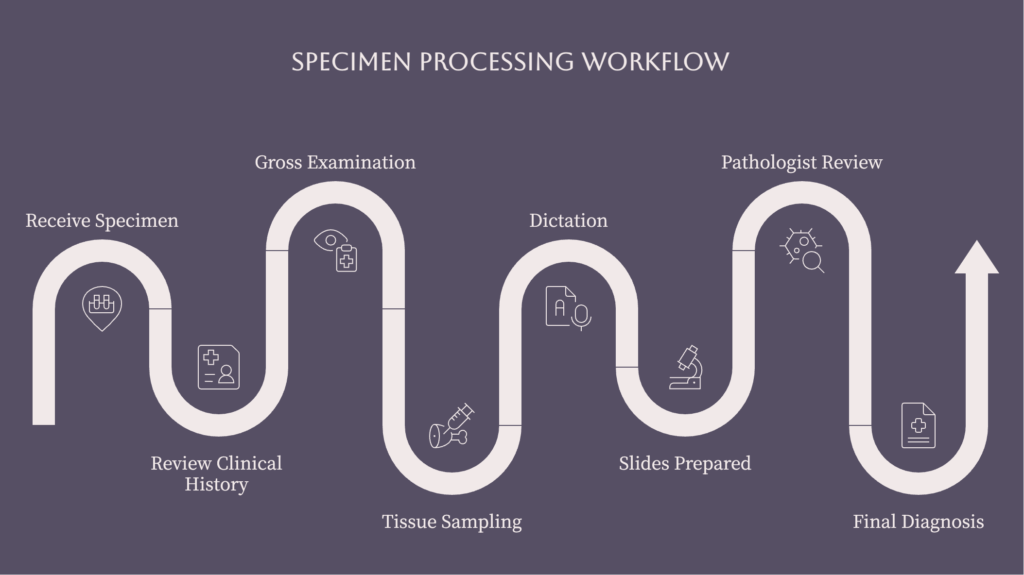
Knowing where a PA fits in the clinical chain (a laboratory step between surgery and final diagnosis), what grossing involves and why it matters, and what the day-to-day workflow looks like is key. If you cannot speak to this confidently and specifically, it will be difficult to make a strong case that you belong in a training program. If you are researching the profession already and starting to build that picture, you are ahead of many applicants.
Physical Requirements
Being comfortable on your feet for the majority of the day is a genuine asset. I stand for my entire shift. Chairs are available and some people use them at the grossing bench, but I personally find standing perfectly comfortable, and sitting makes performing the job logistically difficult at times. When seated, you will frequently need to get up to grab supplies, answer the phone, pick up a new specimen, or go cut a frozen section. There is a fair amount of movement built into the day even though I don’t generally consider being a PA an active job.
Sitting during an autopsy is not possible – that part of the role requires you to be on your feet and mobile the entire time.
Beyond standing, some degree of hand-eye coordination is helpful. Grossing involves manipulating tissue with forceps in one hand and a scalpel or cutting blade in the other, so comfort with tasks that require that kind of manual dexterity is necessary.
Comfort with the Work Environment
Comfort with blood, body fluids, and human tissue is a must. You would be working with surgically removed tissue, and while PPE is always worn, contact with fluids is sometimes unavoidable. Nobody enjoys getting blood or fluid on them, but handling it calmly – taking a moment to go wash up and moving on – is the mature and professional way to deal with it.
Well-run labs have ventilation systems in place to manage formalin fumes and general odours, but there is no getting around the fact that tissue can sometimes smell bad. Any time a bowel specimen comes in, for example, you are opening it and rinsing out fecal material. Being mentally prepared for that kind of environment is important.
Maturity
Maturity is something I think both programs and employers value, and it is less about your age than about how you conduct yourself. Showing up consistently and on time, working a full shift without complaint, and taking on less desirable tasks – cleaning, QA work, whatever needs doing – without grumbling are all part of it.
There will be moments throughout training that are unpleasant or boring. How you respond to those moments is noticed, particularly by the instructors and supervisors who will be evaluating you. Being able to handle difficulties calmly and professionally makes a significant difference. You will also occasionally have to work with people you do not particularly like. That sucks but you have to deal with it like an adult. Showing up and doing your job well regardless of that is a requirement of any professional environment.
Autonomy and the Ability to Work Independently
Much of what a PA does day-to-day is individual work. You are always free to consult with colleagues or pathologists – I still do both when something is tricky or seems weird – but a lot of the work is solo, and once you are more experienced, that becomes even more true. You will not be supervised closely at every moment, so the ability to self-motivate, stay on task, and complete your work without constant direction is essential. People notice fairly quickly who carries their weight and who does not.
Teamwork and Collegiality
Working independently does not mean working in isolation. You are still part of a team – whether that is one or two PAs in a small lab or eight to ten people in a larger one – and that team includes other PAs, pathologists, medical lab techs, and other lab staff. Being collegial and easy to work with matters just as much as being technically capable.
I have spoken with people in supervisory and managerial positions who have told me they would much rather hire someone who is easy to get along with and occasionally needs support than someone who is highly capable but unpleasant to work with. This does not mean you have to be someone you are not, but if you have a tendency to be dismissive of colleagues or difficult in a team setting, those are qualities worth reflecting on. You don’t have to be everyone’s friend but at least be professional and be a net positive for your colleagues.
Coachability and Receptiveness to Feedback
As a student and even as an early-career PA, you will regularly be guided through unfamiliar cases and corrected when your approach needs adjustment. The willingness to accept that guidance and apply it without defensiveness is a baseline expectation – and for good reason. The PA role carries responsibility as your work can directly affect someone’s diagnosis and treatment, and corrections offered by senior PAs or pathologists are almost always made in the interest of getting it right.
If you have a disagreement with a colleague, whether it is over a critique of your work or something else, addressing it directly and privately is always the right move. The ability to navigate those situations calmly and constructively reflects well on you.
Initiative
Initiative is one of the qualities that I think most clearly separates strong PAs from average ones.
As a student, your supervisors will walk you through unfamiliar cases, help you access patient information, and explain staging parameters and tissue types. That guidance is expected and appropriate. But as you progress toward graduation – and certainly once you are working – there is an expectation that you will do some of the groundwork yourself before going to a colleague or pathologist. Most sites have SOPs for common specimen types, and staging protocols for cancer specimens are available online. Reference textbooks cover a great deal of ground as well. Checking those resources first is what I would consider a baseline expectation of any competent PA.
Initiative also shows up in smaller ways: noticing that a bench is low on supplies and restocking it without being asked, for example. Or doing some independent reading when an unfamiliar specimen type starts coming through the lab more frequently. For example: a new specimen type begins arriving in the lab that staff have not been trained on and are not familiar with. Flagging it to a supervisor or pathologist is absolutely appropriate, and it is something a supervisor should address. But there is also an expectation that you will take some steps on your own to learn what you can in the meantime.
To make that more concrete: the lab I work at does not receive kidney specimens for cancer – those go to a different site in the city. If I were to move to a lab that did get those kinds of kidney specimens regularly, I would do some independent reading to refamiliarize myself with those cases and review relevant staging parameters or other SOPs before starting.
Personal Responsibility and Self-Directed Learning
That sense of ownership extends to your time as a student. Your program will guide your training and your clinical supervisors will be there to answer questions, but there is a meaningful amount of learning you will have to take responsibility for yourself. PA training is not a spoon-fed environment in the way some earlier schooling can be, and the expectation that you will seek out information and fill in gaps independently carries through from the classroom into your clinical year.
Time Management
Time management is a distinct and important skill. During my own clinical year, we were responsible for preparing a presentation as part of monthly PA rounds as well as completing and presenting a small research project, all alongside regular clinical work and ongoing review and studying. Research days were built into the schedule, but making productive use of downtime – finishing early on a shift or having a quiet autopsy day – was expected. Any experience you have balancing competing responsibilities and prioritizing your time will serve you well here.
Academic Performance and Intellectual Curiosity
Programs take GPA seriously, and the applicant pool has become increasingly competitive. Grades are one of the ways applicants are scored, but they are one component among many. What can help you stand out beyond your GPA is evidence of genuine intellectual curiosity – taking relevant courses independently, attending voluntary gross rounds, reading material beyond what is strictly required. Those are the kinds of signals that show a lasting interest in the field rather than simply an interest in getting accepted.
Computer Proficiency
Basic computer proficiency is something I almost take as a given at this point, but it is worth mentioning. PAs use computer systems to dictate reports, work with Word and Excel in various capacities, and take, edit, and annotate specimen photographs using dedicated programs. A solid baseline comfort with computers is beneficial, and in my experience it tends to be stronger among younger applicants than older ones. You don’t need to be a matrix level hacker by any means but IT 101 isn’t that hard to master. , but for goodness sake, if something stops working on your computer, please at least try turning it off and then turning it back on again before you come asking for help.
These are my personal views based on eight years in the field, not official program criteria. But I think they represent a fair and honest picture of what the profession calls for – and what will help you both get in and succeed once you are there.